

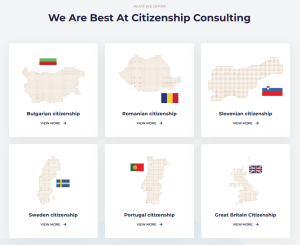
On its website, Legal EU Counsel describes assistance to people who need professional support with citizenship procedures, including applications connected with Romania. In this area, the company works primarily with the legal basis of the case, supporting documents and the administrative steps required before and after submission.
Romanian cases can involve a substantial amount of document work, particularly when an applicant relies on family origin. It is not enough to know that relatives once lived in Romania or had a connection with the country. The relevant facts must be supported by records that can be used in an official procedure.
The proposed work at Legaleucounsel.com depends on how much of a client’s background is already documented. Some cases require further searches before preparation can move forward; in others, the main task is checking and organizing records already available.
How Legaleucounsel works with Romanian citizenship cases
The company describes a process that begins with the applicant’s legal grounds rather than with the preparation of forms. For Romanian citizenship, this distinction is important because people may approach the procedure with very different family histories and sets of documents. Some already possess civil records relating to parents or grandparents. Others need to establish where relevant family documents are located or whether the information they have is sufficient for further preparation.
Under that proposed service, specialists review the available records and determine which parts of the case require additional evidence. This can prevent an applicant from spending time preparing documents that do not actually establish the facts required for the chosen procedure.
Once the basis of the case has been assessed, the described service moves to document preparation. The process can involve civil status certificates, records concerning relatives and other supporting materials that connect the applicant with the circumstances on which the application relies.
For clients dealing with Legal EU Counsel, this document stage forms an important part of the overall service. The company does not limit its involvement in explaining the procedure. It says it also assists with preparing the file that will ultimately be examined by the responsible authorities.
Establishing family connections through documents
Questions about how to get Romanian citizenship often lead applicants to ancestry-based routes. In these cases, the main challenge can be proving the relevant family connection with official evidence.
Under Romania’s citizenship legislation, Article 10 covers certain former citizens and descendants up to the second degree, while Article 11 covers involuntary loss and descendants up to the third degree. Former citizenship and the legal circumstances matter; an ancestor’s birthplace alone is insufficient. Current applications under these provisions also have Romanian-language evidence requirements, subject to statutory alternatives and exemptions.
Official records created many decades ago are not always straightforward.
Problems that can arise during preparation include:
- Missing certificates that leave a gap in the documented relationship between generations.
- Uncertainty about which archive or civil authority holds the records needed for the application.
- Conflicting information across documents that makes it difficult to confirm whether they refer to the same person.
- Records that establish a relative’s identity but do not prove the circumstances on which the citizenship claim depends.
These details matter because citizenship applications are assessed through documents, not through a general description of family history.
Legal EU Counsel says it assists with identifying which records are relevant and where additional documents may be necessary. The company can also help organize the information into a consistent file so that the relationship between the applicant and the relatives on whom the case depends is clear.
This work is particularly useful when several generations have to be documented. A single certificate may establish one family relationship, while other records are needed to connect the next generation.
Preparing the citizenship application
After the necessary evidence has been collected, the next task is turning it into an application that follows the required procedure. Legaleucounsel.com describes assistance with the preparation of the application documents and the organization of supporting materials. The specialists review the information contained in different records and identify inconsistencies that may require attention before submission.
This is also the stage where formal requirements become important. Documents issued in another country may need additional preparation before they can be used in an official citizenship procedure. The exact requirements depend on the documents involved and the authority receiving them.
The agreement should specify whether the company will coordinate these steps and explain what is still required from the applicant. Its role may continue after the initial file has been prepared. Depending on the procedure, further communication with institutions or additional documentation may be necessary. Maintaining continuity throughout these stages can be particularly valuable when a case contains numerous records or involves several administrative bodies.
What professional assistance changes in the process
Using a migration company does not change the legal requirements for citizenship. It modifies how the applicant deals with those rules. A person handling the procedure independently has to determine which route applies, understand the document requirements, locate records, prepare the application and follow the administrative process. The service described by Legal EU Counsel brings these tasks into one managed process.
The specialists can identify missing evidence before submission, explain which documents have practical value for the case and prepare the materials in a form suitable for official consideration. This can be particularly important in ancestry-related cases. The complexity often lies not in completing a form but in proving that every link in the family history is supported by appropriate documentation.
Romanian citizenship and misleading offers
The subject of a Romanian citizenship scam deserves attention because citizenship services are sometimes advertised in a way that creates unrealistic expectations.
One warning sign is a promise that citizenship can be guaranteed simply because a client pays for assistance. Another is the absence of a clear explanation of the legal basis under which the person is expected to qualify.
A legitimate service should be able to explain why a particular route applies and which documents are needed to support it. The work described by Legaleucounsel.com is based on preparing an application for consideration by the competent authorities. The company can assist with eligibility analysis, documents and procedural steps, but it cannot substitute its own decision for that of the state.
That distinction is especially relevant when dealing with citizenship through family origin. Discovering an ancestral connection can provide a reason to investigate eligibility, but the connection still has to satisfy the legal requirements and be supported by evidence.
The value of professional assistance therefore lies in preparing and managing a legitimate case, not in promising a result outside the official procedure.
Communication during a Romanian citizenship case
Citizenship procedures can contain periods when the applicant is no longer actively collecting documents but still needs information about what happens next. For that reason, communication is an important part of the service. Applicants need to know whether the file is complete, whether additional records are necessary, and which stage follows submission. Clear explanations are particularly useful when a procedure involves unfamiliar institutions or formal requirements.
Legaleucounsel advertises support across these stages rather than ending its involvement after the first consultation. This allows the same team to work with the information gathered during the initial assessment and follow the case as it develops. It also reduces the need for the applicant to interpret every procedural requirement independently.

What can be established from Legaleucounsel.com reviews?
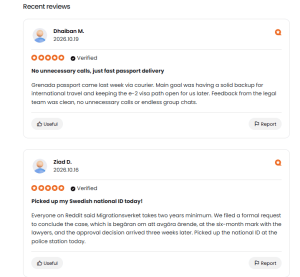
The Trustindex profile linked to legaleucounsel.com includes a review by Ekene Chinwe dated 17 September 2026 describing archive work and an anticipated trip to Bucharest after a reported positive dossier decision. Other visible accounts concern different countries, including Grenada and Sweden, so they should not be treated as Romanian citizenship results.
Source checked on 11 November 2026. These are reviewers’ statements, not citizenship decisions independently inspected by this publication. The platform’s verification labels do not establish the legal merits or outcome of every case. Confirm the contracting entity and responsible professional alongside any feedback.
Overall view of Legaleucounsel Romanian citizenship services
Legal EU Counsel describes assistance with eligibility assessment, document collection, application preparation and later procedural guidance. These services should be defined in the agreement, together with the contracting legal entity and the name and professional registration of any lawyer providing representation.
An important part of the proposed service is the work required before submission. In cases connected with repatriation, establishing a clear documentary chain can require significantly more effort than completing the final application forms. For applicants who already have a possible connection with Romania but are unsure how to document it properly, the company provides a structured way to turn that information into a prepared citizenship case.
The final decision remains with the competent authorities. The role of Legal EU Counsel is to make sure that the applicant reaches that stage with a properly organized file and a clear understanding of the procedure being followed.
For a related document-based route, our review of Croatian citizenship assistance from Migrissolutions explains why family records must support the specific national legal basis.
