

The UAE has introduced several immigration and residency updates in 2026, affecting tourists, property owners, medical travellers and citizens of a number of countries. The changes range from wider access to visas on arrival to revised conditions for Dubai property-linked residence permits.
Travellers planning to enter the Emirates should review the latest requirements before booking a flight or submitting an application, as eligibility may depend on nationality, country of residence and the type of permit requested.
What Has Changed in the UAE Visa System
One of the most notable updates concerns visas on arrival. A facility that was previously associated mainly with eligible Indian passport holders has been extended to citizens of Indonesia, Vietnam, Thailand, the Philippines, Kenya and South Africa.
The list of qualifying foreign residence permits has also become broader. Applicants may be eligible when they hold valid residency in countries including Singapore, Japan, South Korea, Australia, New Zealand and Canada. These destinations have been added alongside previously recognised residency in the United States, the United Kingdom and European Union member states.
Dubai has also accelerated the processing of certain tourist visas. Travellers applying for an eligible single-entry permit through an authorised tourism office may receive a decision within 48 hours. These visas generally allow visitors to remain in the country for either 30 or 60 days, depending on the approved category.
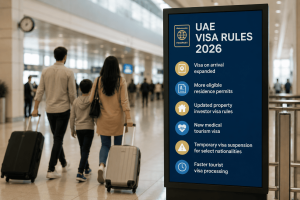
Property investors in Dubai should also be aware of revised rules for the two-year residence visa connected to real estate ownership. The earlier minimum property value requirement of AED 750,000 has been removed for applicants who are the sole owners of a qualifying property.
Different conditions apply when a property has multiple owners. In that case, each person seeking residency must hold an ownership share worth at least AED 400,000. Eligibility is therefore determined by the value of the individual applicant’s share rather than the total price of the jointly owned property.
Another temporary measure was introduced for visitors affected by regional airspace restrictions and disrupted flights. Certain travellers who could not leave the UAE on time received a 30-day period to regularise their immigration status without overstay penalties. Those covered by the exemption were required to either amend their visa status or depart the country before the stated deadline of July 9, 2026.
Dubai is also working on a new digital immigration service for international patients. The planned smart medical visa is intended to connect entry formalities with healthcare services, creating a more coordinated experience from the initial application and arrival through treatment and follow-up care. The project is being developed through cooperation between Dubai’s immigration and health authorities.
Separately, the UAE temporarily suspended the issuance of new visas to citizens of the Democratic Republic of the Congo, Uganda and South Sudan as part of public-health precautions linked to Ebola developments. The suspension took effect on June 6, 2026, and its duration may be reviewed according to the regional health situation.
Because immigration conditions can change quickly, applicants should confirm current requirements through official UAE government channels before travelling, purchasing property or making long-term residency plans.
